In Brief
Feldbinder EUT outlet valve and seals — discharge spout DN100/DN150 with EPDM, PTFE or silicone seal, bottom discharge valve or butterfly valve. Signs of wear: material leakage at the spout, resistance when closing under load, product traces outside the tank. Seal replacement: 2–4 hours. Seal material depends on cargo: EPDM for plastics granules, PTFE for food/pharma, food-grade silicone for dry food. Preventive replacement every 3 years (2 years for food service). PHS Magnum stocks Feldbinder parts, issues service protocol for TDT.
The Outlet Valve Assembly on Feldbinder EUT Trailers
The outlet valve assembly is the discharge point at the lowest part of the Feldbinder EUT tank — the component that keeps the tank sealed during pressurised transport and controls the flow of bulk material during pneumatic unloading. It is the most frequently serviced component on EUT trailers.
Assembly Components
Bottom discharge valve (gated spout design):
- Discharge spout – stainless steel (304L or 316L) spigot welded to the tank floor; DN100 for most EUT tanks, DN150 for high-throughput versions
- Valve body – mushroom valve (poppet) or ball valve, manually operated via handwheel or pneumatic actuator
- Valve seat seal – EPDM, PTFE or silicone ring; the primary pressure-retaining seal
- Flanged connection – at the spout outlet for coupling the flexible discharge hose; sealed by a flat gasket or O-ring
- Stem and gland – valve stem passing through a gland seal; the gland prevents pressurised air from escaping along the stem
Butterfly valve (disc valve design):
An alternative found on newer Feldbinder models. A rotating disc seals against a rubber-lined bore in the valve body. The sealing ring (EPDM or PTFE) is pressed radially by the disc. Advantages: lower flow resistance, simpler disassembly. Disadvantage: replacement requires pulling the disc assembly from the bore, which needs proper tooling.
Material Leakage – Recognising Worn Seals
Material leakage at the outlet valve is the leading cause of trailer downtime in EUT fleets. Recognising the warning signs early prevents cargo loss, contamination incidents and costly roadside breakdowns.
Sign 1 – Product Residue at the Spout After Unloading
A characteristic white or grey deposit around the spout collar or flange — powder or fine granules that have escaped through a degraded valve seat seal during pressurised unloading. This deposit is most visible immediately after a high-pressure unloading cycle.
Diagnosis procedure: Clean the area thoroughly, then pressurize the empty tank to 0.3 bar with air. Apply soapy water or leak-detection spray to the flange and spout area. Bubbles confirm the leak location.
Sign 2 – Resistance Closing the Valve on a Full Tank
A valve that normally closes with one hand now requires a wrench or two-handed force. Possible causes:
- Contamination of the valve seat – fine granules or powder trapped on the sealing face, preventing full closure
- Swollen seal – the EPDM ring has absorbed a reactive cargo component and swollen beyond its original dimensions; incorrect seal material for the cargo
- Bent valve stem – mechanical impact damage; requires full valve replacement
Ignoring this symptom risks stem fracture and uncontrolled valve opening while driving.
Sign 3 – Flange Leakage When Discharge Hose Is Coupled
Leakage visible at the bolted flange joint between the discharge hose coupling and the tank spout. Cause: worn or cracked flat gasket or O-ring at the flange face. Simple repair — gasket replacement — but untreated it risks cargo spillage during unloading.
Sign 4 – Corrosion or Deformation of the Spout
Visible rust spots or pitting on the outer surface of the spout, particularly at the weld toe where the spout meets the tank floor. Possible causes: passive layer damage (Cr₂O₃) not restored after a previous weld repair, use of incorrect steel grade in a prior repair, or chloride contamination from cargo. Repair requires spout replacement and passivation of the new weld.
Seal Replacement Procedure at PHS Magnum
The outlet valve seal or full valve assembly replacement follows a structured procedure:
- Assessment and diagnosis – visual inspection of spout, valve, seals and flanges; pneumatic leak test (0.3 bar, 15 minutes); stem movement test
- Parts ordering – Feldbinder valve seals and spout fittings are stocked at PHS Magnum or sourced from Feldbinder-approved suppliers within 2–5 working days
- Disassembly – unbolt flanged connections, remove the valve from its seat, clean the seating face with stainless-safe abrasive pad
- Spout assessment – check the weld root and wall thickness; if corrosion or thinning is found, repair by 304L/316L certified welding before reassembly
- New seal or valve assembly fitting – torque flange bolts to Feldbinder specification; apply food-compatible thread sealant if specified
- Leak test – pressurize to 0.5 bar with air, hold 30 minutes; verify zero leakage by soap solution on all joints
- Service protocol – date, scope of work, parts used and material certifications, test result; document required by TDT at the next pressure vessel inspection
Standard completion time for a DN100 seat seal replacement: 2–4 hours.
Seal Material Selection – Matching the Cargo
Correct material selection determines how long the seal lasts. Using the wrong material for the cargo results in premature degradation, swelling or contamination risk.
Plastics Granules (PE, PP, PVC)
Recommended material: EPDM (ethylene propylene diene monomer)
- Operating range: –40 to +120°C
- Good resistance to steam, diluted acids and alkalis
- Unsuitable for contact with mineral oils or fuels
- Most common choice for PE/PP granule transport
Dry Food Products (Flour, Sugar, Starch)
Recommended material: food-grade silicone or EPDM FDA-grade
- Food-grade silicone: soft, odourless, tasteless; –60 to +200°C; compliant with EC 1935/2004 and FDA 21 CFR 177.2600
- EPDM FDA-grade: harder, more abrasion-resistant, FDA 21 CFR compliant
Chemical and Pharmaceutical Products
Recommended material: PTFE (polytetrafluoroethylene)
- Chemically inert to virtually all substances
- Operating range: –200 to +260°C
- Required for aggressive chemicals, pharmaceutical GMP cargo and highly acidic products
Abrasive Mineral Powders (Chalk, Kaolin, Talc)
Recommended material: EPDM, hardness Shore A 70–80
- Harder compound resists erosion by abrasive particles
- Inspect more frequently (every 4 months) – abrasive powder accelerates wear
Preventive Replacement Schedule
| Component | Inspection interval | Preventive replacement |
|---|---|---|
| Valve seat seal | Every 6 months | Every 3 years or 300,000 km |
| Flange gasket / O-ring | Every 6 months | Every 2 years (food) / 3 years (other) |
| Gland seal (stem seal) | Every 12 months | Every 5 years or at leak |
| Full valve cartridge | Every 12 months | Every 8–10 years or on damage |
| Discharge spout | At TDT inspection | On corrosion or weld damage |
For food-grade and pharmaceutical service, tighten the above intervals by one cycle and document every replacement in the cleanliness record.
Feldbinder Spare Parts – Stock at PHS Magnum
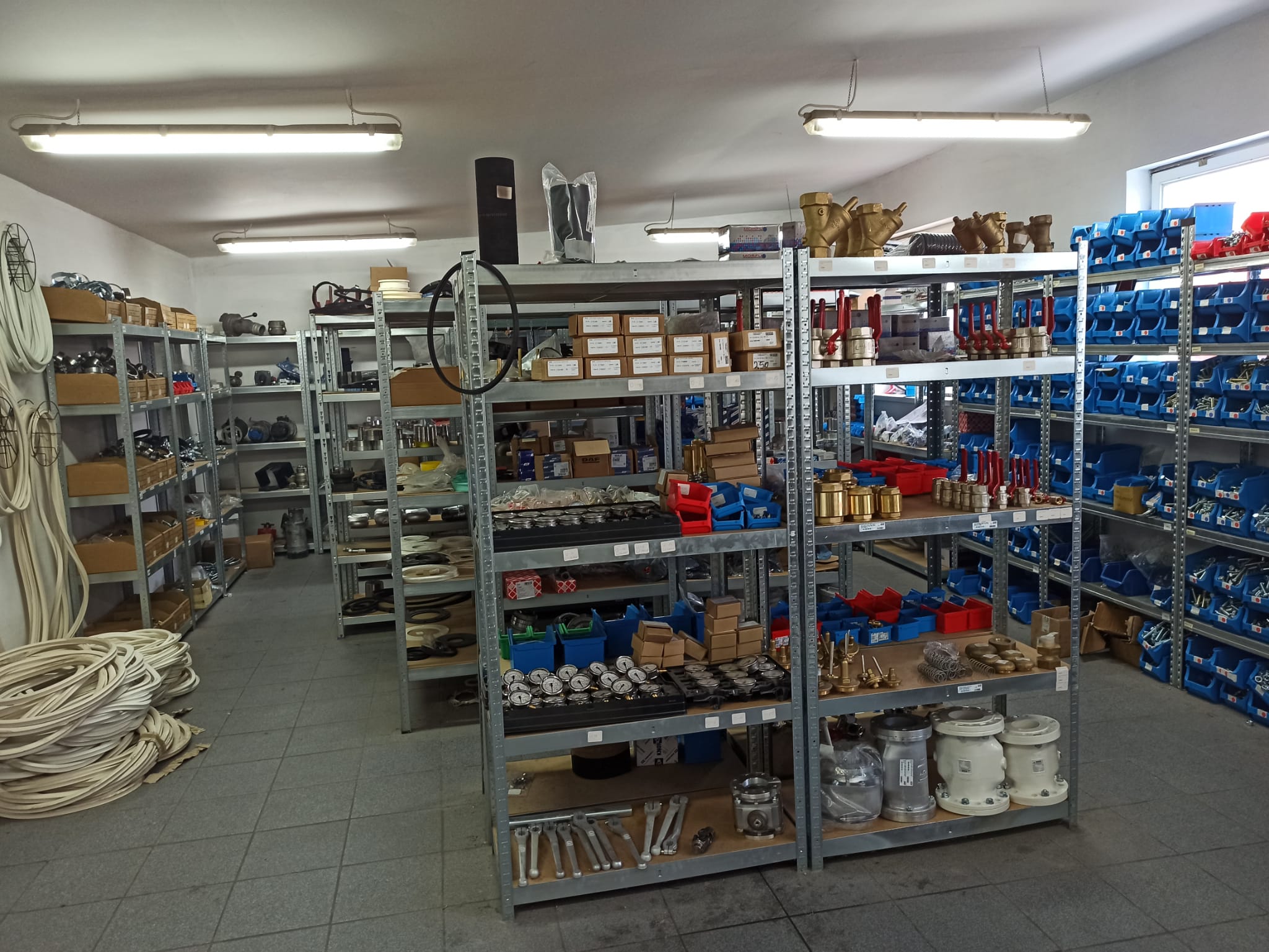
PHS Magnum maintains a stock of Feldbinder EUT outlet components:
- Valve seat seals DN100 and DN150 (EPDM, PTFE, food-grade silicone)
- Flange gaskets and O-rings for discharge spout connections
- Bottom discharge valves and butterfly valve cartridges
- Discharge spouts in 304L and 316L stainless steel
- Stainless steel flange bolts and nuts (A2/A4)
Full spare parts range: Spare parts Feldbinder
Contact: +48 602 716 551 · biuro@magnumchorula.pl
Related: Feldbinder trailer service · TDT testing · Repair & renovation · Stainless steel passivation